


Twin Peaks Topics is a series where I interview people from the Twin Peaks community about a topic of their choice. For the first edition, I spoke with Lindsay and Aiden, the hosts of Bickering Peaks about violence towards women on the show.
Andrew: Lindsay, you recently wrote an article called “It’s a World of Bobs” and I was going to see if you could give a brief description of what that article was about.
Lindsay: It came to my attention by December or January, once the #MeToo and #TimesUp movements picked up and were starting to make waves that I thought, you know, is it necessary for us to reevaluate some of the media or the things that we love about pop culture in light of this? Is that something we need to do? And I thought “I’m going to look at Twin Peaks in this light.” So that’s what the article was really about, taking a look at that through the eyes of someone who had seen and been impacted by the #MeToo and # TimesUp movements. I don’t want to criticize David Lynch and say that he absolutely is guilty of something that he’s not. I don’t think that he’s a misogynist and I don’t believe that he or Mark Frost are any way implicated in #MeToo and # TimesUp movements. But there are certain things that come up again and again in David Lynch’s work and especially in Twin Peaks regarding violence against women and especially sexual violence against women. And then in Season 3, it seemed like that was amped up to a really heightened level. So I just wanted to look at if that was really necessary to tell the story that needed to be told? In the end, I wasn’t sure if it was or not but there were certainly things that were troubling about it, and I think people had picked up on that as well, but nobody was really sure how to talk about it. I think even now; maybe it’s too early to really think about that. But I wanted to give it a shot anyway. Especially after Roxanne Gay wrote an article about Roseanne, looking at that in light of current events and Molly Ringwald wrote one about reevaluating The Breakfast Club. So I thought, you know, other people are doing this too, so maybe it’s not completely out of the left field to kind of approach Twin Peaks in that kind of way.
Andrew: Aidan, was this something that you had thought about prior to Lindsay’s article?
Aidan: I considered it for sure but it wasn’t top of mind. I’d always kind of taken a bit of a hands-off approach to the sexualized violence in Twin Peaks because I was just like, “Well they’re just reflecting reality and I think that’s still a fairly justifiable way of looking at it.” But Lindsay, you know, she told me about this article and I’m skeptical the whole time. I was like, “Well, you know, that’s what they’re doing. They’re just showing what happens and it’s terrible and it seems egregious but that’s because it’s still happening.” After I read the article, I was like, “Oh yeah, you know what? You’ve got a really good point.” That was kind of my journey through it because I did really start off as kind of a skeptic.
Andrew: Lindsay, you said you didn’t come to any definite conclusions. Do you still feel that way now that you’re a little bit removed from writing the article?
Lindsay: You know…part of me wishes I’d taken a little bit more of a stand and I think if I had sat with this for another few months, I might have taken more of a stand on it. I think that’s just the nature of this discussion is that it evolves in my thinking. So, if you ask me today, I might say something different than I would say tomorrow, but I’m not angry at the show for doing what it does. I’m not angry at Lynch and Frost for poking at that question or dealing with these issues. I don’t think that it’s a bad thing. I think people who have been through a trauma like that are going to respond to it much differently than I did or than somebody else might. So it’s a really personal journey and I think that’s something that anybody will say about Twin Peaks, that everybody comes at it from a different place. I do think there is an element like Aidan said about holding a mirror up to society and showing what actually exists. I think that that is necessary too but I do think that it was over the top at times.
Andrew: This question is to both of you. What would be some examples that you consider the most extreme and potentially unnecessary acts of violence towards women throughout the third season?
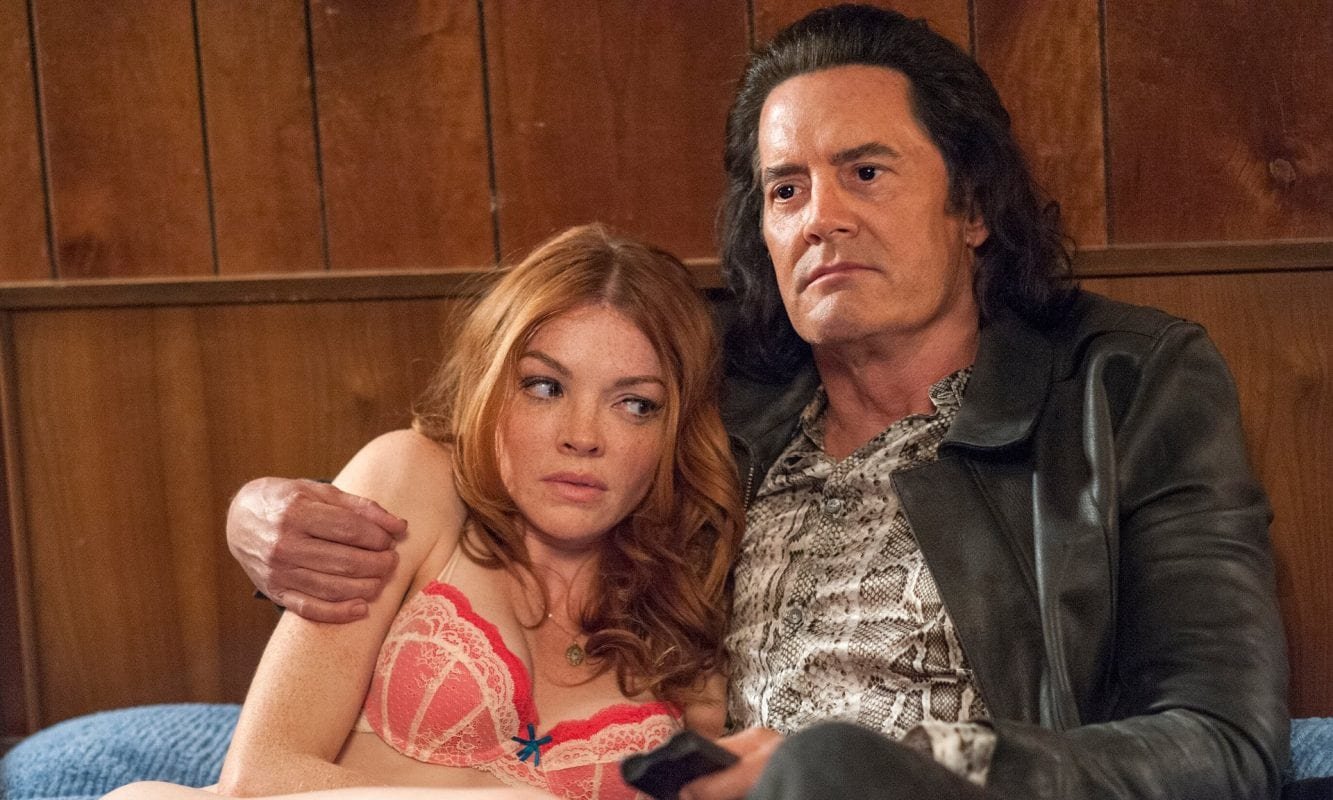
Lindsay: I think for me, the biggest one that comes to mind right off the top of my head is the violence against Darya in Part 2. It’s particularly sexualized. She’s scantily clad, and Mr. C is fully clothed, and there’s just an extra layer of vulnerability there that I feel really uncomfortable with. I feel that that was a little bit unnecessary. She didn’t have to be half naked and there didn’t have to be a sexual relationship between the two of them. She could have just been someone who snitched on Mr. C and it didn’t have to have that extra layer of vulnerable sexuality glossed over top.
Aidan: The one that always jumps to my mind was Lorraine. It’s an office full of women and three women get killed in the span of like a single minute on screen or something like that. It’s the most brutal murder in Twin Peaks in my opinion because it’s personal. It’s bloody. It doesn’t have any of the emotional impact that Maddy getting killed had, but it’s shown almost to the same level, it zooms right in on the stabbing motions, and you hear it. And it’s squirting blood, and there’s this playful music to it. It’s just that it didn’t really seem that needed quite so much, especially because they’re minor characters. It always bothered me.
Andrew: David Lynch and Mark Frost are obviously known for a lot of different things. For those that follow Frost on Twitter, [we] know how socially conscious he is and David Lynch has a reputation with some of his female characters, not in every film, but in a few where they go through this journey of being beaten down only to emerge victorious somehow in the end. Even in the case of Laura Palmer, victorious in death. Knowing these things about them, does that change your opinion at all? Do you think that perhaps there was something more that we should be looking at as viewers or was this just a case of them perhaps not being quite as up to date with social themes as we would like them to be as viewers?
Lindsay: That’s a great question because I think this conversation, the larger conversation, has kind of branched out. They (Lynch and Frost) haven’t come out and said anything about this in terms of their work. Maybe it doesn’t matter; maybe they don’t need to say anything. David Lynch never says anything about this work. I think that their approach is perhaps a little bit harsh, but I think that ultimately they’re trying to do the same thing that other people were doing. They just have a different method of achieving that.
For David Lynch to always have a woman in trouble like that’s his M.O. — it’s a big motif for his films—it’s to achieve a certain narrative end. So it’s something and who knows why right? Complex psychological reasons why an auteur would go back to the same wellsprings for years and years and years? But it worked for him, and he tells his stories the way he wants to tell them by doing that. That’s what he does. But it does have — it has consequences I guess because if you’re constantly showing women in trouble and virtuous men who try and save them and either do or don’t, or the woman maybe saves herself or doesn’t— there are various ways of looking at that. It kind of makes that whole damsel in distress play out a little bit cliched, almost in a sense. Not that anything in David Lynch’s films are cliched…
Aidan: He plays with tropes and clichés and does different things with them. But yes, he does come back to the same one over and over. Maybe it’s just because, as you said, it just works for him. So he goes back to it because he knows that he will be able to generate that emotional response. He knows that the damsel in distress evokes a certain response from the audience and you know, the spins that he puts on it, the response can be mitigated and transformed a little bit by those things. Like when you watch Inland Empire and a female character or characters, depending on how you understand that movie, are having trouble, but at the same time she’s having dance sequences to Kylie Minogue songs and it’s all part of this journey of the characters being in trouble. It doesn’t feel quite like a typical damsel in distress, but at the heart of it, it still is. And I think that’s — to get back to your question, Andrew, eventually—it’s hard to judge that because they’ve always been at least a negligent case. He’s always been kind of keeping that artistic distance from the trope. So, with that in mind, it’s kind of both. It makes it easier to say when its cliche and abuse of women and also harder because he literally separates the cliche quite often, but he still relies on the cliche to get that initial emotional response. So, it’s really hard to say, I think.
Andrew: You already touched on what was going to be my next question. You compared the death of Lorraine to the death of Maddy, and you even noted on the emotion behind Maddy’s death. I want to dive a little bit deeper into that. What makes those situations different for you? Maddy’s death has often been referred to as one of the most violent things that anyone’s seen on television. How does the act of having more emotion in the story not make it more acceptable, but perhaps easier to ingest as part of the story, when compared to a cold killing like, Lorraine?
Aidan: We got to know Maddy, we got to see her and watch her, you know, and her death is tied up also with the reveal of Bob. This whole journey into this chaotic kind of place, that’s all tied together into that one moment. Whereas with Lorraine, I’ve seen her two times. She’s been on the phone in an office, and then in that same office, she comes and gets stabbed. We don’t have any connections to any other storylines or to the character herself: we don’t really care that she’s dying. So the visual, you know, the grossness of it really takes over. That’s all you remember about it. Whereas when Maddy dies, you remember, “Oh my god, this is Bob, and oh my god, Agent Cooper, what are you doing? Why are you at the Roadhouse?”
Lindsay: If I can add something here. This was something that came up in conversations with other writers and editors at 25YL. I was kind of workshopping the essay before and there’s this element of an anonymous death. Lorraine dies and it’s like almost nameless. She’s on the screen for all of however-many seconds and then she died. And so it’s like, how if there is no emotional connection, why does it bother us? And that that might be a commentary on the wider problem of, you know, excessive reporting of violent acts or desensitization of our culture towards violent acts.
Andrew: One of the other big topics that I wanted to bring up was the sexual violence with Audrey and Diane being the prime examples in Season 3. Now we have known since early Season 2 of Twin Peaks that it was a story of sexual violence. Even before we knew who Laura Palmer’s killer was that it was the story of an abused girl, that she was a prostitute, and that her life went down a very sexualized road as a result of the abuse that she endured. We knew that sexual violence was a big component of the story. Season 3 introduces two more victims in Audrey and Diane of Bob or Mr C. However you choose to define that, and the reaction was much different. People were upset. How did that sit with you knowing that Twin Peaks has a history of sexual violence towards women and then these two characters, one who is a franchise player and then the other who’s the name that we’ve known from the beginning, are now introduced as victims of rape.
Lindsay: I was one of the first people to bring that up on the site about the show. It’s like, “Oh, something bad happened to Audrey and Richard is the result and this is not good.” And people were like, “No, how could you think that, this is awful?” And it’s almost like there was this like suspension of disbelief, almost that people were like “That’s not what they show is about.” But that’s what the show was from the beginning. And if you’re going to deny that then you’re denying Laura Palmer, you’re denying everything that happened to her. You’re denying every single one of her experiences and you’re also denying the very real story of what happened to Audrey and what we find out happened to Diane as well.
Aidan: You know, we’ve talked about violence against women and how that was at the core of the show all the way from the beginning—it’s a dead body we start with, so that was always there. So that kind of leads me away from thinking that they’ve kind of overdone the violence because that’s what the show started. You knew it was going to be there. I think they amped it up and you know, they didn’t create the emotional resonance of it for the physical violence so much the sexual violence, with Audrey and Diane. Two of the characters we knew in the very first episode of the show – granted we only knew Diane through Cooper – but these are two of the most important female characters in the show and they were the most important to Cooper. So it makes a lot of sense that they were the victims and it lends a little more credence to the overall idea that the creators had a purpose for what they were doing.
They were hitting us where it hurts, not so much with the physical violence, like with Miriam or Sylvia Horne. Those instances were really brutal and violent and hard to watch, but it was the sexual violence that really came to the emotional guts. We don’t see sexual violence; it wasn’t like we never saw someone being raped on screen. We heard about it, and that is an important distinction to make because maybe that’s where they drew a line in the sand or like, you know, “We’re not gonna do that even though it’s shown in Fire Walk With Me.” It wasn’t shown in Season 3 even though it was talked about. And I think that that is important to note. You couldn’t have shown all of Laura’s journey without her coming to that realization of who Bob was in her bedroom. That’s the emotional climax of the movie in a lot of ways.
Here they did it differently. The stuff that they dealt with on-screen about sexualized violence is Diane remembering and breaking into tears when she sees Cooper again. Audrey’s not able to get to precisely what it was or remember the experience of it, maybe because she wasn’t perhaps conscious for it, but I mean that dislocation, the fact that you don’t know where Audrey is, it’s kind of a metaphor for exactly for the outcome of that. The sexualized violence, to me, it was far more interesting and nuanced than the other violence in Season 3.
Audrey and Diane’s sexual assaults
Andrew: It’s really interesting to me because like you guys said, it wasn’t mentioned or expressed the way that Diane vocalized it. We had to put the context clues together through Doc Hayward giving us the narrative pieces. I do think that it hits the audience a lot harder, partially because we discovered it without it being her to tell us. Then partially because she was such a beloved character. Laura Palmer was dead when we started the show, but she became a loved character despite being dead. Audrey in many ways, was the equivalent in Season 3. She was a female lead who all of a sudden was put in this really vulnerable position. I think that did kind of give people that emotional gut punch. Is the fact that it was Cooper instead of Leland this time around perhaps what made it a more difficult pill for people to swallow?
Lindsay: Absolutely. I think the reveal we learned in Season 2 was heartbreaking and disturbing because that was Laura’s father, so it was incest and rape and murder all rolled up into one. So that is different, it’s on another level. To have Cooper, who is a character that we came to love over the course of 29, 30 hours of television or more. Then we know that we left him at the end of Season 2 in this horrible, precarious situation and I think we kind of all suspected that if his double was out there in the world, this was probably going to happen. But then find out that it happened to Audrey and it happened to Diane. It’s like he’s the hero but all of a sudden he’s not because he’s done these horrible things. I think what would have been really interesting to see on screen was the full Cooper, the whole Cooper, the Cooper who re-emerges from the Red Room as a whole person again, grappling with what his double did, the murders and sexual assault, the rape, all of that stuff that, that was done in his stead when he was trapped in this place would have been such an interesting thing to a horrible thing to experience as viewers.
We didn’t see that ultimately, but I think that as a character that was supposed to represent everything that was pure and everything that was good and everything that was righteous. To know that a) that he committed these crimes and b) if you continue with John Thorne’s theory, that this was half of Cooper, the part of Cooper that left the Lodge and was doing these things. So, it’s a part of Cooper that did these crimes. Then it means that Cooper is somehow culpable for it. It’s tough to swallow. It kind of makes you question the whole cult of hero worship that we have around. Not just him, but maybe all heroes. It makes sense. Leland was horrible, but Cooper was much harder because we always knew him as a good guy.
Andrew: This question is for you, Aidan. Lindsay brought up that she wishes she could have seen the whole Cooper come to terms with everything that happened. This is where I slightly disagree because I do think that we saw that. So, I’ll pose this question: Cooper says to Diane in Part 17, do you remember everything? This was prior to the frozen Cooper face. Do you think that that was perhaps a recognition that Cooper, that version of Cooper that we saw there, that we saw, did know everything that had happened and he was confirming with Diane that she did?
Aidan: I feel like yes but it’s an odd thing because there’s a Cooper that’s in the last two episodes, and there’s a line between when we get “I am the FBI” Agent Cooper and when we get the “true Cooper”—is what I call him—which is the one that you see with Carrie Page. I think the line between those Coopers is not super clear in the whole transition, you know, when they’re in the car and when we switch over, everything is different. Is he the pure, true Cooper at that point already or is it when he first unmasks Diane? There’s a whole lot of uncertainty about who he is and all those moments in time because everything is so odd. I would tend to agree that the question is weighted with that knowledge that does she remember everything? Does that include her as Naido saving Cooper?
When you’ve reviewed the purple world scene knowing that it’s Diane, she’s still willing after everything that Cooper inflicted on her. She’s always willing to sacrifice herself seemingly for him, She ended the banging or whatever that was, for a little while at least, and changed it so that he could go into the back to the real world and she was flung off into space, so it definitely—that’s how I interpret that question. I don’t know which version of Cooper’s asking it, but I feel as the audience we’re supposed to think when she says yes, it’s like, yes, she remembers being raped, she remembers all this, and she still wants to go through everything with him. So, I feel like they insert a bit more agency. I think that’s kind of like the true Diane that we’re finally seeing. The whole tulpa Diane problem also bothers me because, you know, if Mr. C created her, she remembers things, and we take her words at face value when she talks about how she was raped, but there’s always that shadow hanging over it of why would he create a tulpa that remembers that? Why would he not create a tulpa that just loves Mr. C and is equally into evil?
Lindsay: I think that there’s a powerful metaphor there for what happens to a person when they are sexually assaulted or when they have a trauma inflicted on them. They compartmentalize themselves, and they have to be able to deal with it somehow, and some people manage, and some people get through it and are able to lead successful lives without, you know, going through years and years and hundreds of thousands of dollars of therapy and some people can’t. Maybe this is Diane; the “tulpa” was created by Mr. C when he raped her because that’s a different Diane than the Diane that let him into the apartment. There was a different Diane at the end of the night and that’s when the “tulpa” was “created.” I’m having some problems navigating the real world and what is manufactured.
Aidan: There is uncertainty about how that process works. Which is always going to make it easier to kind of downplay what happened to Diane. Which is a shame because I agree with you, that’s how I kind of interpreted it—as a metaphor. When Phillip Gerrard says someone manufactured you, and she says, “fuck you.” Mr. C created her out of the trauma, out of the garmonbozia. The thing that gets messy with it all is that Dougie doesn’t seem to be manufactured that way; he’s blissfully ignorant the whole time. It’s interesting to think of how different things are created.
Andrew: The final topic that I wanted to bring up and we are going to have to kind of veer into theory world as well, but there’s no way that we could have the conversation about violence towards women and Twin Peaks without discussing Laura Palmer. With the character arc that we saw for Laura and Carrie Page in Season 3, there was a lot of debate and discussion about her agency, whether she was potentially robbed of the outcome that she desired, which was death as we saw in Fire Walk With Me. How do you guys feel about the characters of Laura and Carrie in terms of how they were treated and were they victimized even further in the Season 3 storyline?
Lindsay: I covered it in an article that I wrote back in late September or early October called “The Continuing Education of Dale Cooper”. I argued that he did re-victimize Laura through Carrie and at the end of Part 18, and did rob Laura Palmer of the closure that she needed or that she earned, that she sought at the end of Fire Walk With Me because she didn’t go to the train car and she didn’t die that night. She never got her angel. I mean, the way the timelines flow in Twin Peaks is murky now at best. So it’s possible that maybe that Fire Walk With Me hasn’t happened yet or that it’s still going to happen. We don’t know. But there is an element and…I have to wonder about this, just that the way that Mark Frost and David Lynch talked about Season 3 and the way that they kind of stomped on all of our—for the most part—on all of our expectations and our nostalgia and everything like that. I have to wonder if they didn’t take Cooper down a peg and say, you know, this hero that you guys had been worshiping, this guy that you guys have put on this pedestal for the last 25 years, he’s not actually that great. This is what the result is of a guy who thinks that he can do everything and he thinks that he is, you know, the ultimate good guy, who buys into the myth, and this is what ends up happening and that this is wrong.
If I’m right and that ending for Laura Palmer has been removed or changed in some way then I can’t see Frost or Lynch—especially, because of how much he loves Laura Palmer—I can’t see him taking away Laura’s happy ending easily or without sacrificing something else. And if that sacrifice has to come in at the expensive of destroying this hero that he created, I can see him doing that. I think he loves Laura Palmer enough that it would be acceptable to him. He’d say “You know what? If Laura doesn’t get a happy ending, it’s because Cooper ruined it.”
Aidan: Alright, let the bickering begin. I think that Laura’s essence at the end of the day was really complicated in Season 3. There’s the whole Judy/BOB combination and how the combination of the two of them will lead to the end of the world as in The Final Dossier. I think when you start getting into the metaphorical aspects of who Laura is and how Cooper interacts with that, I think that at the end, Laura is achieving what she needs to do and she’s led to it by Cooper, but it’s not the pure, innocent Cooper that we grew up with. It is the final Cooper that we see, the “true Cooper” who has merged his dark self. I’ll never speak ill of that scene in the diner in Odessa when he shoots the guys in the foot and deep fries the guns. It’s just like Mr. C, and it’s just like Cooper in this harmonious package. I feel like that Cooper that we see there is not the innocent one. He knows what he’s doing. He knows that there’s going to be bad consequences, perhaps, but he’s willing to see them through because they lead to the best outcome for Laura. He’s looking out for Laura’s interests in my mind. Maybe exposing her to Sarah and Judy is perhaps not the best but Laura Stewart published an article and to summarize it poorly, Judy is the memory of suffering. BOB is the one who creates suffering and feeds off that and Judy is the remnants that are left behind. I think Laura Palmer screaming and destroying the lights out of Judy’s home is a great way to end the series. Laura was finally confronting the memory of her trauma and defeating it. That’s how I view the end.
Lindsay: If you view the ending that way, where does the ending of Fire Walk With Me fit?
Aidan: I think that there are two separate endings. I think they are kind of incompatible. Fire Walk With Me is beautiful and positive for Laura in the sense that she is free of the suffering. She no longer has to face BOB. She had an angel on her side to see her through the death essentially. I think even though she no longer has to worry about BOB, she’s free of that and she didn’t let BOB take over herself. Her soul is still hers; she still has that memory. Even if she’s dead waiting 25 years in the Red Room, that bad memory is still there for her. The fact that Cooper tries to preempt that suffering by taking her away before she was murdered, but then finds her as Carrie Page later on, is indicative that her death was not the source of her pain, it was her life that was the source of all her pain. If Judy is the memory of that, then he has to take her. Not to run away from BOB but to confront the memory of that. I feel like Laura’s theory really kind of wrap things up for me.
Lindsay: If there are multiple timelines and if the ending of Fire Walk With Me could still exist in some way and if she did find her angel at the end and that ending happened or could still happen—is there a parallel universe? Is that where Carrie went when she was taken? So maybe you’re right, and maybe Cooper did have to go to Odessa and did have to take Carrie who still had maybe some suppressed trauma because she lived through that and then was spirited away to Odessa and forgot or had that memory erased. So she had to confront that. I don’t know. I still think that his confusion at the end is indicative that maybe he wasn’t on the right path.
Aidan: Sure, but I also think that something did happen and the fact that we do hear Sarah Palmer’s voice. Something has happened, and it’s definitely not clear.
Lindsay: That we can agree on. It is definitely not clear what happened!
No responses yet